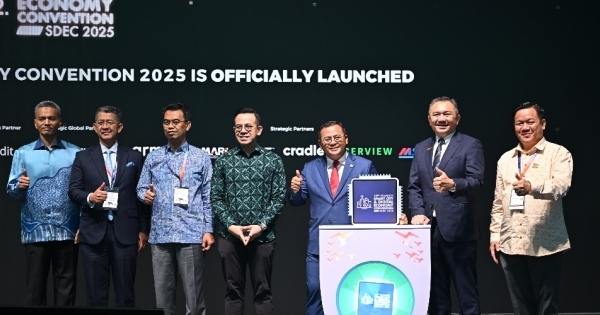
New partnerships & initiatives strengthen R&D & open opportunities for local talent Event reinforces Selangor’s role as Malaysia’s hub for semiconductor & AI innovation The Selangor Smart City & Digital Economy Convention (SDEC) took place last week, marking a milestone in Malaysia’s drive towards becoming a design-led, innovation-driven nation. Organised by the Selangor Information Technology & Digital Economy Corporation (Sidec), the four-day convention ran from 8 to 11 October 2025 under the theme “AI × Semiconductor: Blitzscaling Malaysia’s Deep Tech.” The officiating ceremony included the launch of SDEC 2025 by Amirudin Shari, menteri besar Selangor (pic), alongside distinguished guests, followed by the acknowledgement of new semiconductor partners, reinforcing Selangor’s role as Malaysia’s data and chip innovation hub. A key highlight was the announcement of Synopsys’ expansion in Malaysia through Intelligent Circuit Engineering Sdn Bhd a significant step towards strengthening the nation’s semiconductor R&D capabilities and opening new career pathways for Malaysian engineers. The event also witnessed a Memorandum of Understanding exchange between Cheah Hun Wah, representing Oppstar Berhad, and Dr Simon Hsu, representing AsicAI Co. and serving as executive director of AIRIS Labs. This partnership aims to advance collaborative innovation in IC design to develop Arm-based AI-RAN chips through Oppstar’s subsidiary, AIRIS Labs Sdn Bhd another bold stride in Selangor’s mission to build a globally competitive deep-tech ecosystem. Over four days, SDEC 2025 featured two flagship summits Semiconductor Innovation and AI Innovation, alongside the Malaysia Semiconductor Recruitment Day and the Selangor Twin Accelerator Programme. Together, these events showcased Malaysia’s accelerating shift towards a design-led, innovation-driven digital economy powered by talent, technology, and collaboration. Building on Selangor’s emergence as Southeast Asia’s fastest-growing digital hub, SDEC 2025 positions the state at the heart of Malaysia’s semiconductor and AI ecosystems. This year’s programme featured renowned speakers including Prof Jack Sun (former CTO, TSMC), CK Tseng (president, Arm ASEAN), June Paik (CEO, FuriosaAI), Jim Keller (CEO, Tenstorrent), and YH Simon Hsu (director, NARLabs Taiwan), who shared insights on how AI and semiconductors are transforming global industries. Complementing these discussions was the Malaysia Semiconductor Recruitment Day 2025, connecting top engineering talent with over 30 semiconductor companies offering 500 career opportunities making it the country’s largest hiring event for the deep-tech sector. Highlighting the convention’s mission, Yong Kai Ping, CEO of Sidec, said, “SDEC 2025 is more than a conference it is Malaysia’s bridge to the future of deep technology. By uniting the worlds of artificial intelligence and semiconductors, we are shaping the next decade of innovation made by Malaysia, not just made in Malaysia.” As main sponsor, Affin Group played a key role in empowering Malaysia’s digital economy by supporting entrepreneurs and technology-driven SMEs. Syed Mashafuddin shared, “Affin Group is proud to stand alongside Sidec and the Selangor state government in advancing Malaysia’s deep-tech ecosystem. Through strategic collaborations like SDEC 2025, we aim to bridge finance and innovation, fuelling growth for startups, SMEs, technology enterprises and large companies that will define Malaysia’s next decade of digital leadership.” Marking its tenth anniversary, SDEC 2025 underscored Selangor’s decade-long commitment to advancing the digital economy through landmark initiatives such as the Malaysia Semiconductor IC Design Park and the Selangor Twin Accelerator Programme. The convention was supported by strategic partners including Xendit (strategic payment partner), Plug and Play APAC (strategic global partner), Arm, Malaysian Investment Development Authority, Malaysia Digital Economy Corporation, Cradle, Cyberview, Malaysia Semiconductor Industry Association, Malaysia Automotive Robotics and IoT Institute, and Internet Alliance. As Malaysia’s deep-tech ambitions gain momentum, SDEC 2025 stands as the region’s most comprehensive platform to connect innovation, industry, and investment cementing Selangor’s position as the launchpad for Southeast Asia’s next wave of digital breakthroughs. Continue reading SDEC 2025: Where AI, chips, and talent converge in Selangor→