


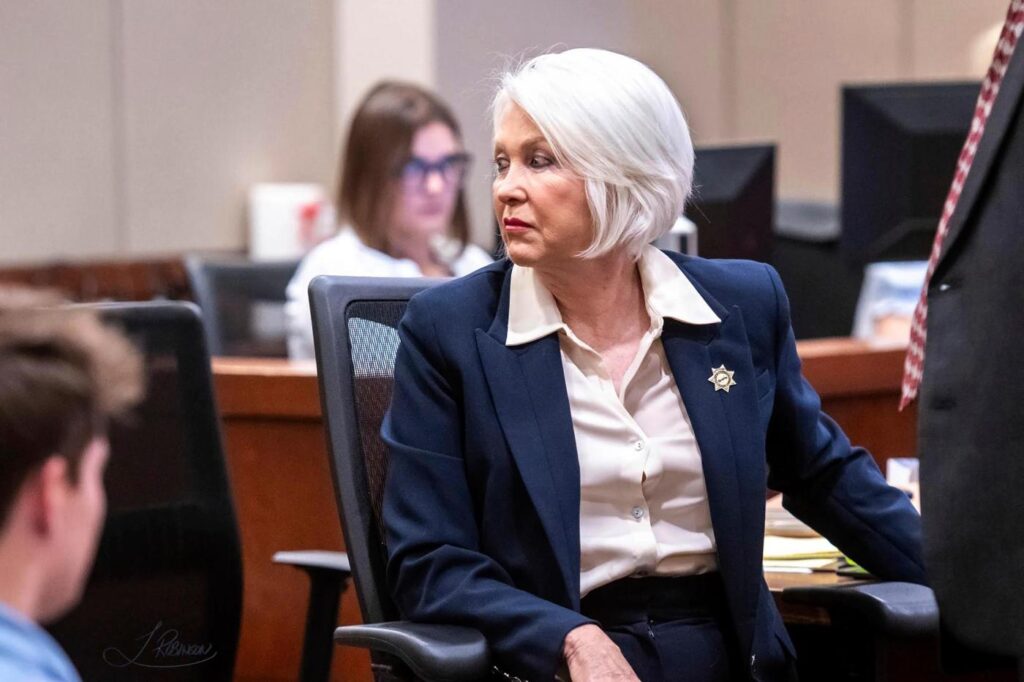
President Donald Trump claimed to grant former Colorado county clerk Tina Peters a “full pardon” Thursday night—a power that constitutional law experts say he cannot wield for a person convicted of state-level crimes.
Peters, 70, is serving a nine-year sentence in a state prison in Pueblo for felonies related to providing unauthorized access to voting equipment when she was the elected clerk and recorder of Mesa County. She had worked with prominent election deniers in an attempt to prove discredited claims that voting machines had been manipulated, and she has been a prominent supporter of Trump’s debunked claims of fraud in the 2020 election.
On Thursday evening, Trump posted to his Truth Social account:
> “Democrats have been relentless in their targeting of TINA PETERS, a Patriot who simply wanted to make sure that our Elections were Fair and Honest.”
> “Tina is sitting in a Colorado prison for the ‘crime’ of demanding Honest Elections.”
> “Today I am granting Tina a full Pardon for her attempts to expose Voter Fraud in the Rigged 2020 Presidential Election!”
However, Trump can only grant pardons for federal crimes, not for those committed against the state, as Peters was convicted of.
“Trump has the constitutional power to pardon people for crimes against the United States,” explained Jessica Smith, a Denver-based attorney with the firm Holland and Hart. “Peters was convicted of crimes against Colorado. To suggest he can pardon for state crimes would upend fundamental principles of federalism.”
As of 6 p.m. Thursday, no formal pardon document had been released on the federal government’s clemency website. An attorney for Peters could not immediately be reached for comment on the president’s post.
An attempted pardon by Trump could be used by Peters’ attorneys as the basis for further filings in state or federal court.
Peters has been treated as a sort of martyr for fellow election conspiracy theorists, including Trump. Since his return to office in January, Trump has repeatedly threatened, insulted, and otherwise sought to cajole Colorado Governor Jared Polis to grant Peters leniency.
Most recently, the Trump administration sought to move her to a federal prison, where it would have more say over her conditions. State corrections officials rejected that request, considering it improper.
On Monday, a federal judge in Colorado ruled that his court did not have the authority to release Peters while she appeals her 2024 conviction through the state courts. Peters’ legal team has argued for her release citing her illness, her mother’s hospitalization, and her being held in solitary confinement.
However, legal experts assert that Trump does not have the power to intervene in the state case. Doug Spencer, a constitutional law professor at the University of Colorado, echoed Smith’s sentiments and warned that Trump’s post may send a dangerous message.
“It is sad that our president hasn’t read or doesn’t understand a basic tenet of the U.S. Constitution,” Spencer said. “This post carries no legal weight. It is a political stunt—and a dangerous one because it may lead others to believe that he has some power over her case, and that those involved in her case in Colorado have acted inappropriately or illegally, for which there is absolutely no evidence.”
Governor Jared Polis holds the power to pardon Peters for state crimes. His office did not immediately return a request for comment Thursday evening.
This is a developing story and may be updated.
https://www.denverpost.com/2025/12/11/donald-trump-attempted-pardon-tina-peters/