


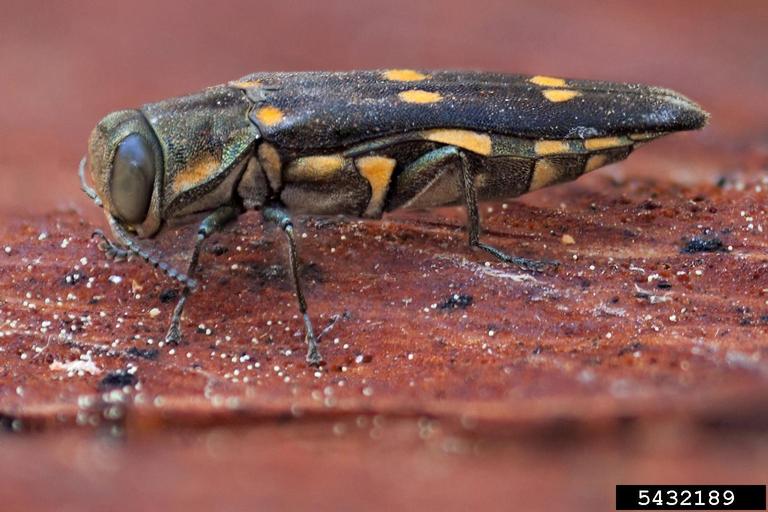
**Goldspotted Oak Borer Poses Growing Threat to Santa Clarita Valley Oak Trees**
The goldspotted oak borer (GSOB), an invasive insect known for targeting oak trees, has recently been found in Placerita Canyon and other areas of the Santa Clarita Valley. Local officials and organizations are working together to mitigate this growing threat and protect the region’s beloved oak woodlands.
In October, UC Agriculture & Natural Resources partnered with the Los Angeles County Parks and Recreation Department to launch a community effort focused on monitoring oak trees at Placerita Canyon State Park. According to Cristhian Mace, an L.A. County natural areas biologist, they assembled volunteers to observe 20 to 30 oak trees for any signs of GSOB larvae.
Signs of the oak borer were previously detected in Whitney Canyon and East Canyon by members of TreePeople. Knowing how close the pest was to Placerita Canyon, biologists took proactive steps to address the issue before it could spread further. TreePeople, an environmental nonprofit focused on creating a climate-resilient Southern California, uses research and sustainable solutions to protect and restore natural resources.
Volunteers and experts closely inspected the oak tree bark for D-shaped exit holes, signs of GSOB larvae, and canopy thinning—key indicators of infestation. From these observations, two oak trees tested positive for GSOB, while several others were flagged as suspicious.
“What this tells us is that GSOB has probably been here for a while. Not a long while, but it looks like it’s starting to establish itself,” Mace explained. To empower the community, experts trained volunteers how to identify signs of the invasive insect so they could monitor open spaces near their homes and become stewards for the local landscape.
“With GSOB in the environment, we have to act now,” Mace emphasized. “It’s just the early days of GSOB here at Placerita Canyon, but there is an extreme opposite end to this story.” In Marshall Canyon, located in the San Dimas area, GSOB infestations have resulted in ongoing oak tree mortality. In August, part of the Marshall Canyon Trail was temporarily closed to allow for the removal and trimming of affected trees and to reduce the risk of the pest spreading to new areas.
Placerita Canyon is home to thousands of oak trees, and the broader Santa Clarita Valley has tens of thousands more. The extent of infestation helps officials determine the best mitigation strategies. If a tree has more than 25 D-shaped exit holes, it’s considered an “amplifier tree,” meaning it harbors a larger breeding population and poses a higher risk of infestation to nearby oaks. Such trees are labeled as hotspots.
“Sometimes the only solution is to chop the tree down,” Mace noted, though many factors are considered on a case-by-case basis.
The speed at which GSOB can kill an oak tree depends largely on the tree’s health prior to infestation. Stressed trees decline more rapidly, much like people with chronic illnesses are more vulnerable to disease. Interestingly, biologists have observed that the oak borer often targets healthier trees, which provide better survival prospects for the insect.
GSOB’s life cycle involves beetles laying eggs in the bark, with larvae tunneling beneath the surface and remaining there until mature enough to reproduce. This enables generations of GSOB to persist in the same tree year after year.
The goldspotted oak borer is not native to Southern California. It was first discovered in 2004 in San Diego County, having originated in Arizona and northern Mexico. How the pest traveled such a distance across states confused researchers, as “they’re terrible flyers,” Mace said. The culprit, they discovered, was infested firewood. When campers or outdoor enthusiasts bring firewood home from trips, they inadvertently transport the pest to new areas.
“If you have leftover firewood from a camping adventure, leave it behind. It’s all about buying local and using it all up wherever you are,” Mace advised.
In some areas of San Diego County, GSOB has decimated up to 90% of oak woodlands. However, early detection efforts in the Santa Clarita Valley have offered hope. County agencies continue to monitor oak forests from Sand Canyon to Green Valley to catch infestations early. GSOB was found in Green Valley years ago and has since been mitigated.
“As long as we arm ourselves with knowledge, and keep our hearts open, all is not lost,” Mace said. “L.A. County’s team is so passionate—tiny, but mighty in their efforts to confront this issue. We want to save every single tree that we can.”
https://signalscv.com/2025/12/oak-killing-beetle-found-in-placerita-canyon/